
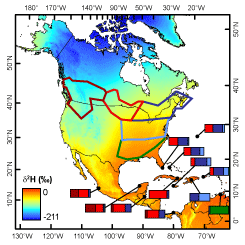
The H and O isotope ratios of many tissues from migratory animals exhibit relationships with the isotopic composition of local environmental water. As such, isotopes can be used as inherent tracers of animal movement. The relationships observed in natural systems are highly variable and noisy, however, leaving open the question of whether further ecological information is recorded in these tissue/environment relationships. Previous work in human and invertebrate systems suggests that regional or temporal dietary variation can be identified and quantified using data from these isotopic systems, but relatively little is known about the strength, ubiquity, and applicability of these relationships within migratory systems.
This project supported postdocs who develop, tested, and improved models for isotope-based tracking of animal migration.
Among the key questions addressed were:
Bowen, Cerling, Hobson, Popp, West, Wunder
Image after Norris et al., 2006, Ornitological Monographs

The Waterisotopes Database is a community resource for isotope data discovery and sharing. Find or contribute data by clicking on the image above!